
Written by Kee Shao Yee and Aston Tan
In Malaysia, the manufacturing sector is a key contributor to the nation’s economic development. To regulate and facilitate growth in this sector, the Malaysian government, through the Malaysian Investment Development Authority (MIDA), administers the issuance of manufacturing licences under the Industrial Coordination Act 1975 (‘ICA 1975’). A manufacturing licence is mandatory for certain manufacturing companies operating in Malaysia. The process is governed by a defined regulatory framework, eligibility criteria, procedural steps, and key legal considerations involved in obtaining a manufacturing licence from MIDA.
Legal Framework for the Requirements of a Manufacturing Licence
The requirement for a manufacturing licence is governed by the ICA 1975. Section 3 of the ICA 1975 stipulates that no person shall engage in any manufacturing activity unless a licence is obtained from the Minister of Investment, Trade and Industry (MITI), with MIDA as the implementing agency. Under the ICA 1975, manufacturing activity is defined as ‘… the making, altering, blending, ornamenting, finishing or otherwise treating or adapting any article or substance with a view to its use, sale, transport, delivery or disposal and includes the assembly of parts and ship repairing but shall not include any activity normally associated with retail or wholesale trade’.
Eligibility Criteria for a Manufacturing Licence
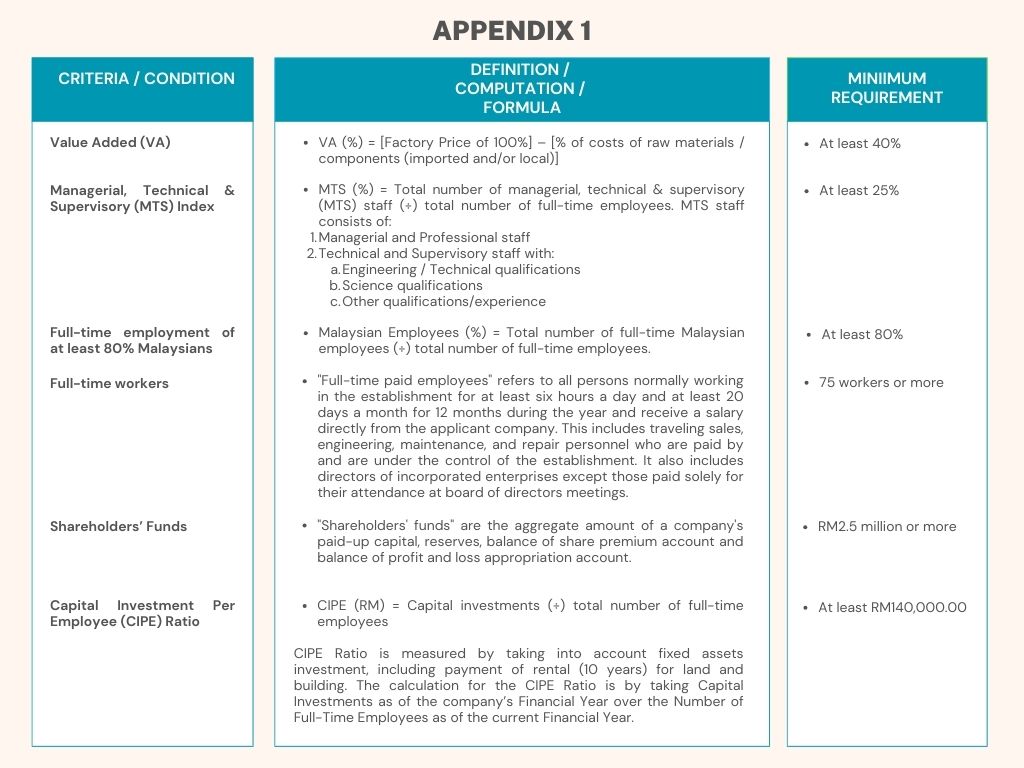
To qualify for a manufacturing licence in Malaysia, a company must either:
- have shareholders’ funds of at least RM2.5 million; OR
- employ 75 or more full-time paid employees.
The following also must apply:
- The project must achieve a minimum Capital Investment Per Employee (CIPE) of RM140,000.00;
- The company must maintain a workforce where at least 80% are Malaysians;
- At least 25% of the company’s full-time staff should comprise managerial, technical, or supervisory (MTS) personnel with relevant qualifications (degree and/or diploma/certificate), OR the product manufactured must have a minimum value-added content of 40%.
- The proposed project must also align with national economic and social policies and support the orderly development of Malaysia’s manufacturing sector.
Processing Timeline
Generally, MIDA aims to process a complete application within four to six weeks, subject to the complexity of the project and the completeness of the supporting documents.
Application Process
Applications for a manufacturing licence must be submitted online through https://investmalaysia.mida.gov.my. Applicants are required to register a company profile and provide the required supporting documents, including:
- Company’s profile and background;
- Detailed business and manufacturing plan;
- Machinery list and equipment, indicating their locations within the approved manufacturer’s premise;
- Manufacturing process flow chart;
- Details of project cost, workforce, and shareholders’ funds; and
- Relevant local authority approvals (if applicable).
Upon submission, MIDA will assess the application and may issue queries or request further clarification. Timely and complete responses from the applicant will facilitate a smoother evaluation process. If the application is approved, MIDA will notify the applicant via email, after which the decision letter can be downloaded from the InvestMalaysia portal. The decision letter may include conditions that the company must observe throughout its operations. Failure to comply may result in suspension or revocation of the licence under Section 6 of the ICA 1975.
Exemptions from Manufacturing Licence Requirements
Some businesses in Malaysia are exempted from requiring a manufacturing licence from MIDA and they may apply for a ‘Confirmation Letter For Exemption From Manufacturing Licence’. Companies with fewer than 75 full-time employees and shareholders’ funds under RM2.5million can apply for an exemption by submitting an ICA10 online application to MIDA.
Additionally, certain activities are automatically exempted, including:
- Milling of paddy into rice;
- Milling of oil palm fresh fruits into crude palm oil; and
- Production and processing of raw natural rubber of all types, including latex, skim, sheets, crepes, scrap, technically-specified rubbers, non-standard and modified rubbers, or any other unvulcanised form of natural rubber prepared by any patented or technically specified procedure.
However, companies not required to obtain a manufacturing licence may still register voluntarily with MIDA to access:
- Tax incentives (eg, Pioneer Status, Investment Tax Allowance);
- Duty exemptions on machinery and raw materials under the Customs Duties (Exemption) Order 2017 and the Sales Tax (Persons Exempted from Payment of Tax) Order 2018; and
- Investment incentives under the Promotion of Investment Act 1986 and the Income Tax Act 1967.
Conclusion
Obtaining a manufacturing licence in Malaysia requires careful preparation and adherence to regulatory requirements set by MIDA under the ICA 1975. Companies planning to commence or expand manufacturing activities should ensure their proposals align with national policies and fulfil the eligibility criteria. Early engagement with MIDA, supported by accurate documentation and clear project details, will help streamline the application process and support long-term compliance.
*Note: Please refer to Appendix 1 for Definition / Computation / Formula.
Published on 9 May 2025